Saturday, November 15, 2014

Salt and Katie are the fictional representatives of two of the first cats to come to North America, and thus the ancestors of the domestic cats living here today. Their story is told in Salt and the Sea Venture. If you believe your cat is a descendant, e-mail me a picture, and a bio of your cat to mgill0627@aol.com. I'd like to feature them on the blog, and may even immortalize them in a future book.

Really how could you find a more perfect Descendant?

Cece is an all-white cat, just like Salt from Salt and the Sea Venture.


This beautiful girl is just over 3 years old. Isn't she lovely. Look at those eyes and that darling pink nose.  She is currently available for adoption at Wayside Waifs. If you're in the area, take a look at this snow white beauty, or any of the other cats at the shelter. 

Friday, November 14, 2014

Dear Writer,… Love, Your Bookseller
Friday, November 14, 2014
5:54 AM
In addition to being a writer myself, I am also a children's bookseller. I can't even explain how wonderful it is to help a parent or child find just the right book. I find the opportunity to consult with customers about something so dear to my heart to be terrifically fulfilling. I've also learned a great deal about being a writer from working in a bookstore. I hope to share some of those insights.

DON'T JUDGE A BOOK BY IT'S THICKNESS


Here's a typical scenario in the bookstore. A kid picks up a book and without glancing at the cover, the blurb or jacket-flap, and definitely not opening the book; they flip the book horizontal. What are they looking for? They are trying to determine how thick the book is. 90% of those making such an evaluation are looking for a "thin" book. I kid you not, this is how they decide if it's something they want to read.

They pay no attention to the size of the print, the amount of dialogue/white-space, illustrations, etc. They simply want to know how thick it is. If it's too thick they won't even consider it. Now this isn't all kids by any means and there are the 10% who do the same, and say the book is too thin. I just think it's amusing that many kids use this as their benchmark for book selection.

As a writer though, it make me realize that every word and every page counts. If there's anything unnecessary in the book that will make it "fatter," it could cost me a sale. To me the sweet spot for Middle Grade is 120-240 pages. Any less, and a teacher might not accept the book for required reading. Any more and the thickness is going to turn away potential readers.

An author who does a great job at this is Lauren Tarshis with her "I Survived" series. These books are wildly popular with Middle Grade readers. Both boys and girls are equally interested, but it's an awesome series for reluctant boy readers. The question of whether or not a person could survive a hostile situation is transcendent. That's why we're obsessed with shows from Survivor to Doomsday Preppers, and why disaster films, and post-apocalyptic fiction are so popular.

But what Lauren has done is to tell her stories in a riveting and concise manner. They are short and quick to read, yet powerful and resonant. Never mind the bonus that the reader learns something about an important part of history. Kids read one, and then come back for more a few days later.

However, I'm convinced that if she had yimmer-yammered on for twice as many pages, they would not attract kids attention nearly as well. They wouldn't pass the "thickness test." Before a kid can get hooked, they have to give the book a try.


Writers- how do you think your books would do in the "thickness test?" Booksellers/Librarians/Teachers- Have you had any similar experience? 

Monday, November 10, 2014

How Long Has it Been?

I know, it's been an insanely long time since I posted to this blog. I'm almost embarrassed, no I take that back, I AM TOO EMBARRASSED to post again, but I'm forced.

Wordpress, the single most frustrating platform ever devised has forced me to tuck my tail between my legs and return to my old blog.

I loved this blog, and all my blogger buddies, but after taking a new job, I just couldn't keep it up. Lucky for me, I got laid-off from that job, so now I have time to focus on what really matters, writing! Yeah.

Can't wait to reconnect, and I apologize for my long absence. 

Wednesday, April 13, 2011

What I Love About You Wednesday

Suzi McGowen

Suzi's a great gal who always has fun things to say on her blog. She's written some great books, including one called A Troll's Wife's Tale. How cool is that. 

Suzi has a great blog that mixes fun writing stuff, with personal tidbits that make her feel like a friend.

Thanks for checking out Suzi's blog.


Tuesday, April 12, 2011

Zoosday Tuesday

Arctic Fox


Powder puff anyone?
The arctic fox is another animal that is beautifully adapted to life in the cold, cold north. The bushy tail, shorter nose, and small ears. Their fur is thick with a dense double coat, and they even have fur on the bottom of their feet. All these adaptations help them survive in the harsh cold of the Arctic Circle.


The blue represents the area where the Artic Fox lives
These little puff balls are opportunistic feeders. They eat small mammals such as lemmings, arctic hares, ringed seal pups, and eggs. They also eat any scraps left behind by polar bears.

My summer coat
During the summer, they grow a brown or grey coat, which they trade for a solid white coat when thick snow covers their territory.


Changing my coat

Arctic foxes form monogomous pairs that share the duties of raising and feeding the young. Litter size is typically from five -eight, but can be up to twenty-five (what! that's just crazy.) The kits stay with the parents for up to two years and may stay with the parents to help raise their younger siblings. When it's time to move on, the females head out while the males stay with the family. The kits are born brown, grey, or blue/grey, and turn white as winter approaches.

Babies at the Den
Arctic Foxes are doing well so far in the wild. They use all of their resources to survive. They are successful hunters, good parents, and ideally adapted to make their way in the harshest environment on earth. 

Wednesday, April 6, 2011

What I Love About You Wednesday

Meet Caz Williams

I was so glad to see Caz Williams back on the blogosphere when I returned from hiatus. She's from, check it out, Perth, Austrailia. Meeting bloggers from places like Perth just makes me want to pee my pants with excitement. (Not that you folks from the US don't make me want to tinkle, but seriously, I never thought I'd know someone from Perth, Austrailia.

And Caz is a writer who's in a similar place to me, so I can really relate to her. Last summer she visited the US and spent part of her time at the SCBWI Summer Conference in LA. (Society of Childrens Book Writers and Illustrators.) She shared so much of what she learned from that experience with her followers.

Check out Caz's blog to see everything she has to say about that wonderful and educational experience.

Tuesday, April 5, 2011

Zoosday Tuesday


Ringed Seal

I'm coming back to Zoosday Tuesday by picking up where we left off in February, in the Artic.

Isn't I cute?

These chubby little guys are the smallest of the seal species.  They get their name from the lighter colored rings on the dark grey or black background.

They are the main food source of polar bears, but before you feel too sorry for them,  keep in mind that they are super fast and sleek under the water. They stay close to the water at all times, by either floating along on ice floes, or digging holes in the ice that they can slip into when a big white bear comes prowling around.

During the winter, when the ice freezes solid the ringed seals are able to dig out holes deep under ice that other seals can't reach. They use their sharp front claws to dig 5-8 holes that they pop out of every 15-30 minutes when they need air.  They blow bubbles out of the hole before surfacing in the hopes that a waiting polar bear will give away his position.


Hope there aren't any polar bears around


They pack on the pounds by eating up to 62 different types of fish and shrimp.

whoops I'm not a ringed seal, but I do have blubber
Anyway they need the extra weight they pack on to get through the molting season. Every May and June ringed seals shed all of their fur and skin so they can grow a new coat.  During this time, they don't eat because they can't go in the water without thier protective coats.  Pupping females add two months to their fast because they don't eat or swim while their nursing their pups.  But pups are weaned after only two months and after four months they are able to fend for themselves.

Ringed seal pups are born with a white coat
They molt this first coat during their first months of life to be replaced by the grey rings.


I is molting, yuck!

These speedy little seals spend most of their life in the water; swimming, fishing, and breeding. They manage to evade their arch enemy the polar bears more times than not.

Monday, April 4, 2011

What I Learned on Hiatus aka I'm Better With You

Better With You

I decided to take a blog hiatus from the end of February - March. I needed to make some major progress on my new WIP, and felt that if I took some time off from blogging, I'd be able to focus on writing. So how did that work out? Not so hot!

I did manage to get around 5000 words written during the month, but considering I wrote 45,000 words during November while blogging, I was less than pleased.

What I found out was that even though blogging takes up time, I'm better with you.

When I'm blogging:
1) Writing is front and center every day. I'm hearing about your writing projects, and it motivates and inspires me to work on my own.
2) I'm part of a great group of people, who all share my goals and keep me motivated.
3) I'm able to chase away the "I'm never going to be a writer" self-doubt that plagues me. I hear about your successes and failures and realize that I'm not alone.
4) I'm getting new ideas and tips on ways to improve my own writing.
5) I'm avoiding other distractions, like the "Game of Thrones" obsession I picked up while on hiatus. (I really did not need to get hooked on new book series. But hey, I only have about 4000 more pages to read!)

So I'm going back to blogging three days a week. I'm going to pick up where I left off on Zoosday Tuesday, Why I Love You Wednesday, and Foenteic Friday. I'm going to focus on moderation and balance between writing, reading, and blogging.

I look forward to seeing all of you soon.

Monday, February 21, 2011

We Interrupt This Blog

I made an important decision last week. As much as I love my current WIP, I don't think I can sell it. But I have an idea for a MS that I think will be great. So to stay on track for my goals for this year, I need to put in some really focused time on my new idea. So I'll be taking a break from blogging through the end of March.

I'll miss all of you, but I plan to use my time well, and be back either April 1st, or mid-April.

Have a good month.

Melissa

Friday, February 18, 2011

Fixtureless Friday

"Perfection is achieved, not when there is nothing more to add, but when there is nothing left to take away."


- Antoine de Saint Exupery

Someone e-mailed me this quote today, and it's perfect for what I want to post about.
 
(I'm taking a break from foenetic friday again.)
 
I've always read that as a writer we shouldn't be afraid to "kill our darlings." And I totally agreed with that. My philosophy is that a great book is XX,000 perfect words, in the perfect order, with nothing added and nothing left out. So when people asked if I would be willing to "kill my darlings," I said, "sure, if they aren't part of the XX,000 perfect words, they've got to  go.
 
I never had any real darlings, but what I did find was a scene that had become a "fixture." You know, that ugly light fixture that you've just gotten used too. The one you don't even notice anymore, until the realator asks, "Are you going to replace that before we list the house?"
 
I finished reading the great book "Save the Cat," and after reading it, went through one of my older manuscripts. I found a glaring "fixture," a scene that wasn't terrible, but it was just sitting there taking up space. It was one of the few scenes that hadn't changed much from the earliest version. It just stuck around, doing less and less as the rest of the manuscript changed. Even after multiple revisions, it was the scene that I always just skimmed, not really looking too closely at it. After reading "Save the Cat" it was so clear that the scene was unneccesary. I had no trouble relegating it to the delete file. I'm just sorry it took me so long to recognize it as a "fixture."
 
So what about you, have you ever found a scene that has become a "fixture?"

Wednesday, February 16, 2011

What I Love About You Wednesday

P V Lundqvist was another one of my early followers. He's the author of the hillarious "It's Not Just For Breakfast Anymore." It's a Middle Grade story about a boy who gets a pet pig, instead of a dog or cat. It's right at the top of my too read list, and it looks great.

He has a wife and three darling kids, one of which is a two year old red-head. Can you get any cuter than that I ask you?

As always I want to thank PV and all my followers.

Not Just For Breakfast Anymore

Tuesday, February 15, 2011

Zoosday Tuesday

***All opinions expressed on this blog are mine exclusively and are not endorsed by the Kansas City Zoo.

AP Polar Bears Concern
POLAR BEAR
Polar Bear- Ursus maritimus is the worlds largest land carnivore. Male polar bears can weigh up to 1300lbs, but females are only half that size.

Polar Bear Range
The polar bear lives exclusively in the Artic (which means with bear.) Polar Bears do not live in the Antartic (without bear). That means that polar bears and penguins could never be friends, because they live on opposite poles. (besides polar bears would eat a blubbery penguin in a second if they could catch them.)


Mother With Two Cubs
Polar bears are solitary in the wild, they only come together to mate, or occasionally when they are isolated in small areas during summer months when the ice has melted. The other time when they spend time in groups is a mother with her cubs. The mother ususally has one - three cubs. Singletons are becoming more and more common as food/ice becomes more scarce. The cubs are born in November in a den that the mother scrapes out of the snow and ice. The cubs weigh less than 2 pounds at birth, but they grow fast on the mothers rich milk. In February - April they all leave the den. Mom finally gets to eat again after 3-5 months of fasting and feeding her young. Unfortunately she only has a few short months to rebuild her fat stores before the sea ice dissappears and she has to fast again.
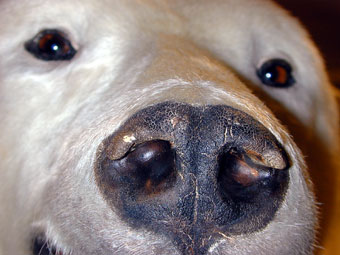
The black tongue and nose match all his skin under his fur
The polar bear is well adapted to life in the artic. They have four inches of blubber covered by black skin which absorbs any available sunlight. They also have hollow guard hairs that appear white, but are actually clear. The guard hairs do not conduct sunlight, but they trap warm air radiating off the bear and help conserve energy. Polar bears are far more likely to overheat than they are to freeze.

A dinner plate covered in tire tread

They are also well adapted to walking across ice. The feet of a male polar bear can be 12" in diameter (about the size of a dinner plate). The bottoms of their paw have black pads which are covered with papillae, tiny bumps that act like the tread on a snow tire. They also have thick fur that gives them excellent traction. This makes it possible for them to creep along the ice to sneak up on a ringed seal. Two inch long claws top off these formidable paws and can be used for traction, to dig in thick ice, and to kill or disable prey. The broad paws also act like paddles to help the "sea bear" swim through artic waters.

See full size image
The nose knows
The polar bears eye site is good, and his hearing is equal to a humans, but his nose puts a humans nose, and even a dogs in the... dust snow. The polar bear can smell a seal from a mile away under three feet of ice. They can smell a dead whale or wallrus on the ice from 20 miles away. ( Manhattan Island is only 13.4 miles long!) Their nose is attached to a long narrow head and neck that's good for swooping into seal's breathing holes, and makes them an aerodynamic swimmer.

Ice Bears
Polar bears depend on thick pack ice to hunt. The thick blubber and fur that keeps them warm, also makes them overheat when they try to chase prey over land for long distances. Even the sea bear can't swim fast enough or deep enough to catch a seal or fish in the water. The only way for them to get a meal is to hunt from the ice.

Ringed Seal Just Under the Ice
Seals spend the icy months swimming from air hole to air hole in the pack ice. When they have to haul out, they dig caves and tunnels in the ice. They are never far from a hole in the ice that they can slip into and disappear.   On land they're essentially a darling little tub of lard with flippers, but in the water they're like Michael Phelps.

Seal Comes Up For Air
Bear Waits Patiently for Seal to Surface

During the summer months when there is no ice, the bears can't hunt for seals. They have to be fat enough to survive until the ice returns. The ice has started to form later and melt earlier every year. This means that polar bears have less time to feed and more and more bears are dying of starvation. Mother polar bears are having more and more single births due to food shortages.

for more information on Polar Bears, check out the Polar Bears International Web Site.

Here's the video I took of our polar bear, Nikita at the Kansas City Zoo. He's a four year old bundle of energy, who already weighs 830lbs. He'll keep growing for another two years or more. He loves to swim up to the visitors at the window and push off.

Friday, February 11, 2011

Fonetic Friday: Word of the Day

I'm bored with Fonetic Friday so I decided to do something different today.

For some reason I just can't seem to get New Orleans out of my head lately. I dream of being able to pack up my stuff every winter and move down there for January and February. I've even started looking at houses for sale, (even though I can't in anyway shape or form afford it, let alone get off work for two months every year.)

So what about you? Do you dream of having a house in a warmer climate during the winter, if so where? Do you already have one? What about people in other countries, Do people have winter homes/summer homes? What are the "hot spots"?

Wednesday, February 9, 2011

What I Love about You Wednesday

Happy Wednesday. It's my pleasure to introduce you all to one of earliest followers, Sharon Kirk Clifton

This lovely lady is from Indiana. Not only is she a writer, she's also a storyteller. This is a skill that I'd love to develop myself, so I'm always interested in the art of oral interpretations of literature.

She's written two middle-grade novels, and teaches eight graders. I always tip my hat to teachers, they're the foundation of our society.

She infuses her blog with her love for Christ, writing, storytelling, kids, and Indiana.

Thank you Sharon for being a follower. Check out her blog here.

Monday, February 7, 2011

Zoosday Tuesday

My planned Zoosday Tuesday post is going to have to be postponed until next Tuesday. I'm having technical difficulties with my computer. I went to the zoo and got some great video of our polar bear, I'm going to get it transferred to my computer and get it posted for next week.

Thanks for visiting. Stop back next Tuesday for a post about polar bears.

Friday, February 4, 2011

Fonetic Friday: Word of the Day

Hey, you know those cool words they make you type when you comment on a blog, the ones that prevent spammers from commenting? If they were real words, what would they mean? See if you can come up with a definition and use it in a sentence.


Today’s word is: Herymor

This is a fabulous new hair replacement product. You just cover the desired area with the thick foam substance, let it dry, and within 24 hours you will have 5 inches of new hair growth.

I accidentally put my husbands herymor on my legs, now I have to french braid my leg hairs.

Have fun! HAPPY FRIDAY!

Wednesday, February 2, 2011

What I Love About You Wednesday

Happy Wednesday!

I'm sending Love to Lynda R Young whose blog WIP It is totally amazing. Lynda is a marvelous woman from down under! I was so excited that one of my very first followers was from Sydney Austrailia! It's so cool to me that someone in Kansas has a blogging buddy in Austrailia. (And now I have several).

Anyway, Lynda is a fabulous writer, but also an artist and photographer. Check out her blog, not only does she always have great advice, she also takes great pictures and posts them. Read
her story, I know you'll find you have a lot in common with Lynda.

So check out Lynda's blog if you haven't already. And Thank You Lynda for being a follower.

Tuesday, February 1, 2011

Zoosday Tuesday

***Any opinions expressed on this blog are mine alone, and do not reflect the opinions of the Kansas City Zoo.***

MALAYAN SUN BEAR

I decided to do one last animal from Indonesia before moving to a different region of the world. The Malayan Sun Bear is the smallest of the eight bear species, with males weighing up to 140lbs. and females around 120lbs. They lie mainly in the Maylay peninsula, and the Indonesian islands of Sumatra and Borneo, but there are some small pockets of Sun Bears as far away as India.

Sun Shaped Crest on Chest
The Sun Bear gets it's name from the white or golden sun shaped crest on it's chest. These can vary in size and shape. They also have golden coloring around their eyes and muzzle.

See full size image
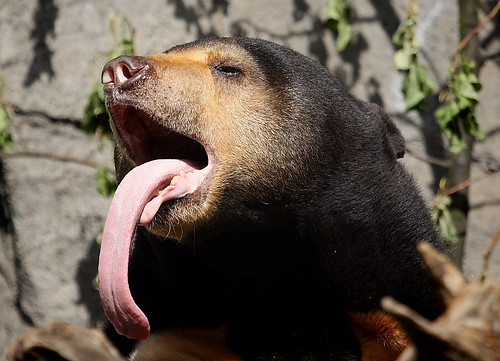
Check out that tongue
Like all bears the sun bear's sense of smell is very powerful, but this bear also has a very impressive tongue. They use their super long tongue to scoop tasty food like termites and larve out of trees. But they also use it to lap up their favorite food, HONEY. They are also known as the Honey Bear.

File:Sunbearskull.jpg
Oversized Canines


See full size image
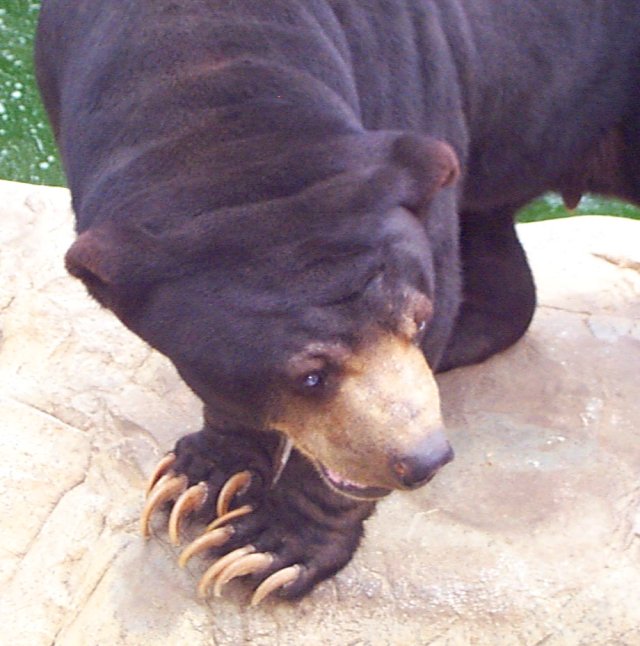
Sickle-shaped claws
The sun bear uses his claws to dig into trees and fallen logs to extract insects and honey. They also eat fruit, leaves, and small animals like lizards and amphibians. The sickle shaped claws and over sized canines of the sun bear make them a formidable opponent for even the largest predators like tigers. They also have loose skin around their neck and upper back that make it possible for them to turn, even in the clutches of a predator and strike with their teeth and claws.

I'm sure you won't be surprised to find that these bears number one predator is man. They have have all of the same issues that plague the other Indonesian animals we've discussed, namely habitat destruction. But like the tiger, these bears are also hunted for body parts used in ancient Chinese medecine. Namely the bile, from the gall bladder of bears is believed to have medicinal properties, used to treat rheumatism.

Mother cradling baby
Sun bears don't hibernate like their cousins to the north, so they can reproduce at any time of the year. (Although they're difficult to study in the wild, there is some evidence that they may be monogomous, but the father is not involved in rearing the cubs.) The mother gives birth to one to two cubs after a 3 month gestation. The cubs weigh just under a pound at birth, and are blind and hairless. Within 3 months they are able to follow their mom around. Unlike most bears, the sun bear has been known to carry her cub by cradling it in her arms and walking upright.

Sun bears are primarily nocturnal and like to spend their nights foraging in trees. During the day, the spend most of their time sleeping in the trees.

Sun Bear Cub

Friday, January 28, 2011

Fonetic Friday: Word of the Day

Fonetic Friday: Word of the Day


Hey, you know those cool words they make you type when you comment on a blog, the ones that prevent spammers from commenting? If they were real words, what would they mean? See if you can come up with a definition and use it in a sentence.


Today’s word is: Scrulty

This is how I've been feeling all week, rather scrulty,  Sick, Crummy, and that's about the best I can do for today. But it's Friday, so hey, what's the worst that can happen?

HAVE FUN! AND HAPPY FRIDAY?

Wednesday, January 26, 2011

What I Love About You Wednesday

My new feature for 2011 is called "What I Love About You Wednesday". Each and every one of my followers has added something unique and wonderful to my life, and I want to reach out to each of you and share what I love about you and your blogs.


My plan is to go in order starting with my very first followers, and each week, highlight someone new. If you're a follower of my blog but haven't been blogging for a while, I'm going to wait until you get back into it. If for some reason you are following my blog, but I'm not following yours, please let me know. I tried to make sure I was reciprocating, but there were a few people I couldn't find.

This week I'm sending LOVE to Jody Hedlund.

Jody's blog was one of the first I ever visited. Her debut novel, The Preacher's Bride, was published on 10/1/2010 .  She shared every step of the process she went through to get her debut on the shelves. She has amazing insight into the publishing industry, and a heart of gold.

If you haven't checked out Jody's blog, I encourage you to do so. I get something amazing out of every post. And that's why I love Jody.